
How the Evolution of Communication Is Redefining the Real Estate Profession

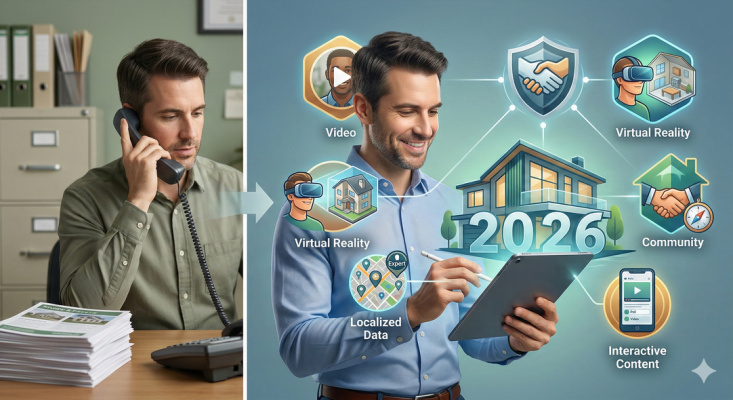
If we go back a few millennia, Cro-Magnon communicated through gestures, sounds, and cave paintings. Survival depended on the ability to share information: where to hunt, how to stay safe, when to move. Then tools appeared. The spear transformed hunting. Fire reshaped daily life. Each innovation made communication more complex and allowed humans to anticipate, plan, and share information more effectively. The Industrial Revolutions accelerated this process: cars, trains, planes expanded networks and shrank distances. The telephone made instant communication possible. The internet erased borders.
Modern real estate communication has accelerated in three distinct phases, each upending the profession:
> The Access Revolution (2000s)
Moving from physical storefronts to digital portals democratized information. Emails, early CRMs, and real estate portals emerged. An agent might manage 50 contacts but spend evenings updating Excel sheets. The monopoly on listings was gone. Clients now arrive informed, having browsed dozens of properties online. The agent’s role shifts from information gatekeeper to guide and expert.
> The Speed Revolution (2010s)
Scheduled appointments gave way to instant exchanges. Social media, WhatsApp, real-time emails, push notifications all compressed decision-making. A client who used to visit three properties over two weeks now tours ten in three days. Instant access became the norm.
> The Attention Revolution (2020s)
We’ve entered the era of hyper-personalization amid information overload. Average attention spans have dropped to just eight seconds. Mass communication no longer works. Only personalized, relevant, timely messages capture attention.
Modern Humans: Welcome to the Age of Scrolling
Today, people live in the moment. They consume information in seconds, flip from page to page, and expect immediate responses.
Social media has shaped new behaviors: digital voyeurism, widespread impatience, a constant craving for stimulation. People want everything immediately, customized to their preferences.
Your clients have become these hyper-connected consumers. They compare multiple agencies, browse listings on the subway, send a WhatsApp at 10 p.m., and expect a reply the next morning. Their real estate project is just a click away and they want you to move at the same pace.
The Asymmetry of Modern Communication: Understanding Client Contradictions
Clients want instant responses but decide slowly: they may react to a listing in two minutes but take three months to sign. They demand an immediate WhatsApp reply on Sunday night but hesitate for weeks on a property.
They want personalization but compare extensively: each client wants to feel unique and individually guided but they consult three agencies at once, review agents on Google, and read online reviews.
They want human interaction but communicate through screens: studies show clients value human connection, yet prefer sending messages over calling. They want to feel your availability without actually calling.
These contradictions aren’t whims they reflect a profound shift in expectations, requiring a new communication approach.
The Paradox of Abundance
The number of available listings has exploded, yet clients feel paradoxically lost. They no longer seek someone to show them properties they seek someone who understands their project and intelligently guides them through the opportunities.
The more information clients access, the more they need an agent but not just any agent. Not one who simply shares information (Google does that better). They need an agent who curates, filters, contextualizes, and guides.
Clients now demand an agent who is:
Responsive: A quick reply signals professionalism. A 48-hour delay can lose a client to a more available competitor.
Consistent: Present without being overwhelming. No contact for three weeks feels like neglect; too many messages dilute impact.
Personalized: Gone are generic emails like “Dear client.” Each interaction must feel unique, understood, and individually supported.
The Neuroscience of Client Attention: Why Consistency Beats Speed
Behavioral science sheds light on what truly works in client communication.
Familiarity builds trust
On TikTok, the first three seconds matter. In real estate, the opposite applies: clients need an average of seven touchpoints before making a decision (compared to three 15 years ago). Not seven rapid contacts seven consistent, spaced, coherent contacts.
Consistency builds memory
The human brain remembers what returns regularly. An agent sending a message every two weeks for three months leaves a stronger impression than one who is hyper-responsive for a week and absent for two months.
Attention is earned over time, not instantly
In a world where people scroll the equivalent of the Statue of Liberty’s height daily on their phones, only constant presence ensures visibility.
AI as a Solution for Scaling
Expectations have skyrocketed but your available time hasn’t. Between showings, listings, and paperwork, AI can help maintain high standards for each contact.
The real question isn’t whether to adopt AI it’s: “How do I maintain consistent communication with dozens of clients simultaneously?”
AI can automatically update contact records, detect intent signals (a client opening the same email three times is “hot”; one inactive for 45 days goes into “dormant”), and trigger timely, personalized follow-ups with the right tone for each client.
Most importantly, it alerts you when human intervention is needed when a client responds, shows strong interest, or when their project evolves. That’s when you take over.
"AI manages consistency. You manage the relationship."
It’s the same logic as the telephone in the last century. No one would say, “The phone dehumanized real estate.” On the contrary, it amplified presence remotely. AI does the same: it enhances your ability to stay consistently present for every client.
At Every Step, the Tool Changes The Profession Remains
Returning to the essence: communicating the right message at the right time has always driven performance in real estate.
What changes today is your ability to do this at scale. With AI, you can be consistent and personalized, present and relevant, available to all and attentive to each.
You remain the one who negotiates, reassures, advises, and guides during the key moments.