
The Real Estate Buyer in 2026: More Informed, More Hesitant, More Demanding
The revival in activity is real. Real estate portals are showing increased consultation volumes, contacts are multiplying, and the number of property viewings per purchase project has risen significantly. Yet decision timelines are lengthening. Purchase agreements are taking longer to materialize.
Buyers are moving forward, but cautiously, as if carrying an invisible weight.
This weight is first and foremost economic. Interest rates, despite a slight easing, remain three times higher than in 2022. French purchasing power contracted in 2025, with inflation—even though reduced—having permanently eroded household budgets. For a growing share of the French population, buying real estate is no longer a reassuring wealth-building reflex: it's a financial commitment perceived as heavy, long-term, and potentially risky.
This weight is also political. Government instability, recurring debates about real estate taxation (property tax, wealth tax, capital gains taxation, the future of zero-interest loans…), contradictory directives around energy performance diagnostics, and persistent uncertainty about renovation subsidies have created a lasting regulatory fog. Buyers wonder whether the rules of the game will change after they sign. This question, often unspoken, is as paralyzing as the numbers themselves.
The 2026 buyer operates in a fundamentally uncertain environment: economically, politically, and regulatory-wise. They're not stuck. They're lucid. And this lucidity makes them demanding, slow, and difficult to convince with traditional arguments alone.
Buyers More Informed Than Ever
You see it daily: some buyers arrive at appointments having done extensive research beforehand, sometimes better than many professionals imagine.
Ten years ago, real estate agents held a comfortable information asymmetry. They knew neighborhood prices, available properties, and actual timelines. The buyer arrived with few reference points and relied on the professional for guidance. That era is over.
Today, before even picking up the phone, the potential buyer has consulted multiple portals (SeLoger, Leboncoin, PAP, Bien'ici…), compared prices per square meter street by street, studied neighborhood trends on Meilleurs Agents, and scrutinized energy performance diagnostics available online. They know what the properties they're about to visit are theoretically worth. They even have an idea of what they could negotiate.
Social media has completed this democratization of real estate knowledge. On TikTok and YouTube, hundreds of creators produce weekly educational content on mistakes to avoid when buying, energy performance pitfalls, hidden fees, second-home taxation, or the subtleties of zero-interest loans. These short formats, often very well produced, reach massive audiences, particularly first-time buyers under 35 who represent a growing share of active purchasers.
The 2026 buyer no longer arrives ignorant. They arrive as a researcher. They have their convictions, their specific questions, and sometimes their preconceptions. The agent who underestimates this level of preparation risks losing all credibility from the first interaction.
Added to this information mastery are simulation tools accessible to everyone: mortgage capacity calculators, rental yield simulators, energy renovation cost estimators. The buyer knows, or thinks they know, what a property will actually cost them over time. This is a major evolution: real estate purchases are now approached as quantified, modeled, analyzed projects. Less as impulses.
More Informed, But Not More Reassured
Information hasn't liberated buyers. It's made them more aware of risks, and therefore more cautious. Here's the central paradox: one might think a better-informed buyer decides faster. The opposite is happening. By accumulating data, they also accumulate doubts. They discover the gray areas: flood risks, upcoming urban projects, aging co-ownership buildings, underestimated fees. They realize that each property is a complex system, and that no simulator can guarantee they're making the right decision.
The economic context amplifies this natural caution. After several years of turbulence, buyers have internalized that real estate can also lose value. A certainty that seemed acquired has cracked.
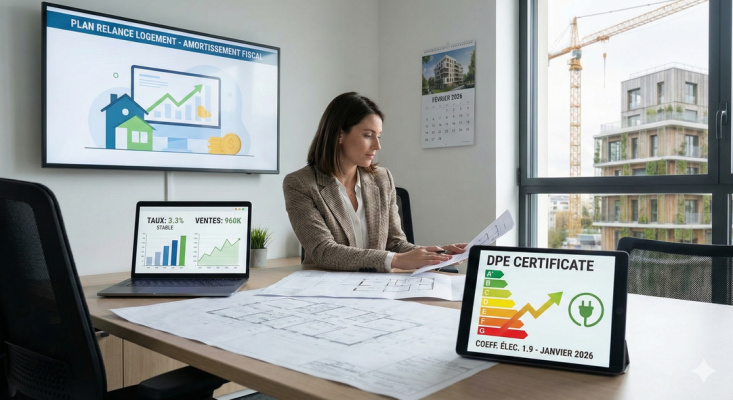
Furthermore, energy performance has become an additional source of anxiety. The energy performance diagnostic is no longer perceived as an ancillary administrative document. It's a risk signal. A poorly rated property means a potentially heavy renovation constraint, a future rental ban, a discount on resale. The buyer weighs all this. They consult contractors before even making an offer. They request renovation quotes. They calculate.
Faced with the fear of making the wrong choice, buyers aren't just looking for a property. They're looking for security, reassurance, and quality educational support. This need for reassurance has become the real challenge in the agent-buyer relationship.
Testimonials from field professionals converge on this point: buyers want to understand, be reassured, feel that they're not jumping into the void. This isn't pathological indecision—it's a rational reaction to an environment perceived as unstable. The agent who understands this has a decisive advantage.
Evolution of the Real Estate Agent's Role
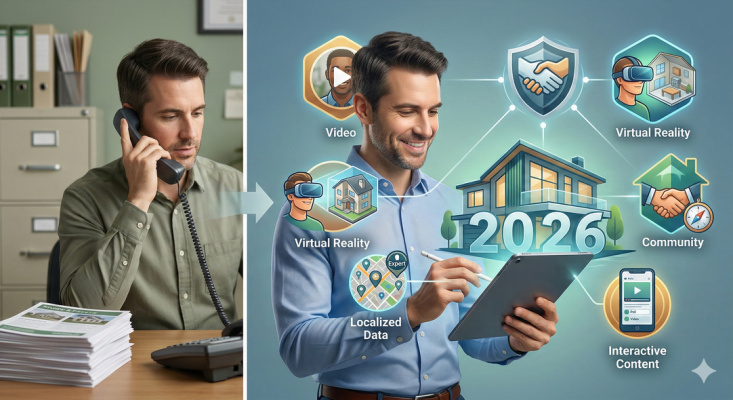
It's no longer just about showing properties. The real estate agent becomes an educator, a journey guide, a reference point in a long and emotional decision-making process.
Practices that worked in a fast-flow market now show their limits. Being the first to call back a prospect is no longer enough. An overly direct sales pitch, centered on property scarcity or decision urgency, produces the opposite effect: it reinforces the distrust of buyers already on their guard. And irregular, sporadic follow-up leaves the prospect alone with their doubts, and often in the hands of another contact who maintained the connection.
What now makes the difference is consistency. The ability to maintain a regular, relevant, non-intrusive presence over cycles that can extend several months. An active buyer in 2026 might visit ten, fifteen properties, hesitate for six months, reformulate their project twice, before signing. The agent who accompanies them throughout this journey, without rushing, without disappearing, becomes indispensable at decision time.
The signature is the culmination of a trust cycle, not a one-time transaction. This paradigm shift entirely redefines the value of a real estate agent.
The quality of information transmitted is also decisive. The well-informed buyer immediately detects approximations, inaccurate figures, vague answers. An agent capable of answering precisely questions about energy performance, co-ownership fees, local property taxes, anticipated renovations, or neighborhood price dynamics—and doing so pedagogically and without jargon—inspires a trust that no digital tool can replace.
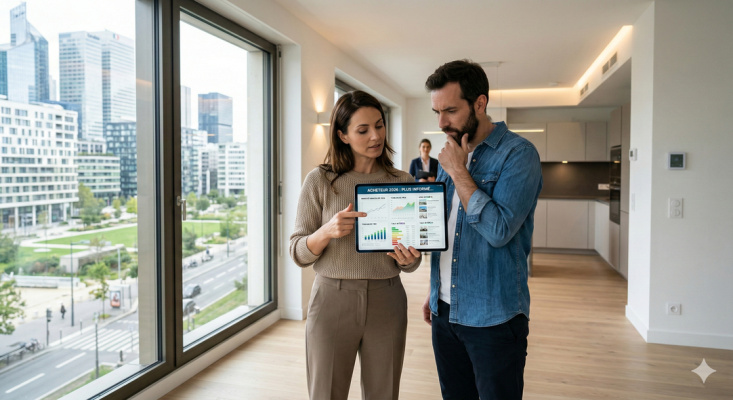
Finally, the posture changes. The agent who performs in 2026 will be the one who has abandoned the seller's posture for that of the advisor. They ask questions. They listen. They help the buyer clarify their project, prioritize their criteria, measure their own compromises. They don't seek to convince: they help decide.
Starting 2026 by Building Lasting Relationships
A slower market has profound structural virtues: it eliminates impulsive decisions, fragile transactions, dissatisfied clients. A buyer who took time to decide is a buyer who doesn't regret. They recommend. They come back. They become an ambassador.
Above all, this context puts methodology back at the center. When the market moves fast, everyone sells. When it slows down, what makes the difference is follow-up consistency, relationship quality, and advisory posture.
Agencies that have invested in their organization now have a real competitive advantage, because hesitant, anxious, over-informed buyers need a human contact who is available and competent—not an algorithm. Agencies that can be this reference point, by structuring their follow-up, maintaining a regular and relevant presence with undecided buyers, cultivating the relationship well before signing, will transform the market's slowness into a strategic advantage.
The real estate market no longer rewards speed. It rewards consistency, education, and trust. This isn't a blocked market—it's a market that demands more methodology. For professionals who understand this, 2026 isn't a difficult year. It's a year of opportunities.