
Commercial Real Estate: Opportunities, Barriers, and a Roadmap for Real Estate Agents
Another Market, Another Set of Rules
Commercial real estate includes office spaces, retail units, industrial properties, warehouses, and mixed-use buildings. What these assets have in common is their economic purpose—and that is precisely what changes everything in the business relationship.
In commercial real estate, buyers and tenants think first and foremost in terms of return, strategic location, and tax considerations. A fully equipped kitchen or natural light in a living room carries little weight compared to a strong gross yield or proximity to public transportation. The result: fewer emotion-driven showings and faster decisions once objective criteria are met.
Fees reflect this logic. On a $500,000 transaction, the gap between a residential commission (3–5%) and a commercial commission (5–8%) represents an additional $10,000 to $25,000. Commercial clients accept these fees without hesitation provided they clearly see the agent’s added value.
Finally, competition is structurally less intense. Many residential agents have not made the shift, leaving room for those who position themselves early. Exclusive listings are more common, and once B2B clients are convinced, they tend to return and refer others.
The Most Common Barriers and How to Overcome Them
Most agents who hesitate tend to raise three main objections. Let’s look at them one by one.
“It’s too technical I don’t know enough.”
This is the most common barrier and also the most overestimated. The actual learning curve is 3 to 6 months, not several years. The key is to start with the most accessible segments: small retail spaces under 1,000 sq. ft. and light industrial units. These properties rely on mechanisms similar to residential deals while introducing agents to commercial lease structures and rental yield analysis. Skills then develop naturally through experience.
Training remains essential to build credibility: applicable tax rules, commercial lease law, and current technical and environmental regulations. Short, targeted training programs are widely available, often offered by professional associations or specialized organizations.
“I don’t have an investor network.”
Good news: investors are actively looking for competent agents in this space. Networks are built they are not inherited. Investor clubs, events focused on taxation and wealth management, and LinkedIn are all powerful entry points. A few consistent posts about commercial real estate are often enough to attract your first listings.
“My software isn’t adapted.”
This is often true. Most residential CRMs struggle with commercial-specific needs: yield calculations, lease management, index adjustments, and expense tracking. Switching to a tool that handles both segments (like the one offered by Agence Plus) is an investment that quickly pays off. A strong commercial CRM does more than centralize data—it structures client relationships and reinforces your credibility with demanding investors.
Your 90-Day Roadmap
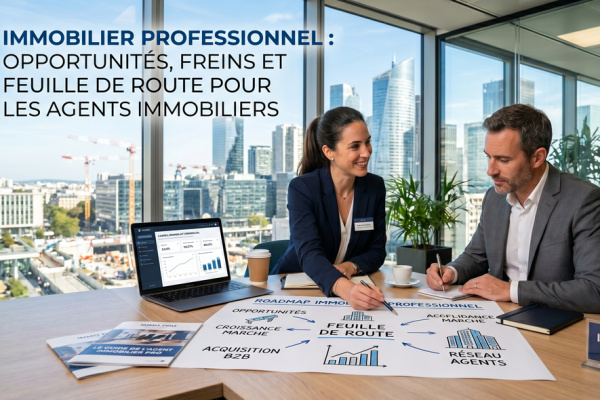
So, how do you get started? Here’s a three-phase action plan designed for residential agents looking to diversify without turning everything upside down.
MONTH 1 – Learn
Take a short course on commercial real estate (taxation, commercial leases, valuation methods).
Review 5 to 10 listings for retail and office spaces in your area. Analyze price per square foot, yield levels, and local market dynamics.
MONTH 2 – First Listings
Target small retail spaces (under 1,000 sq. ft.) within your usual geographic area. Offer your services to business owners looking to sell their lease or business.
Leverage your local expertise—you already understand the neighborhood, foot traffic, and market dynamics.
MONTH 3 – Level Up
Take on a more complex listing: office space, industrial unit, or mixed-use property.
Build an investor network: join clubs and attend wealth management events.
Develop a LinkedIn presence focused on commercial real estate: publish insights, share opinions, and highlight market data.
The 5 Key Skills to Develop
Commercial real estate doesn’t require starting from scratch but it does demand mastering a few specific fundamentals.
1. Understand commercial leases.
Lease terms (the well-known “3-6-9” structure), allocation of expenses between landlord and tenant, indexation clauses, lease rights, and transfer conditions. This vocabulary should become as natural as energy performance ratings in residential real estate.
2. Calculate rental yield.
Be able to distinguish between gross and net yield, factor in deductible expenses and applicable taxes, and present clear figures using simple tools. Investors make decisions based on numbers—not words.
3. Speak the language of investors.
IRR (Internal Rate of Return), net cash flow, long-term asset appreciation—these concepts shape investor thinking. Mastering them allows you to move from intermediary to trusted advisor.
4. Negotiate differently.
Less emotion, more data. In commercial real estate, you don’t sell a “dream home”—you demonstrate an opportunity. Arguments rely on profitability, market comparisons, and future potential.
5. Invest in your network.
In commercial real estate, your network is a true asset. Investor clubs, accountants, specialized notaries, and business attorneys—each connection can lead to a listing or referral. Networking isn’t optional—it’s a growth lever.
Diversification as a Sustainable Growth Strategy
Commercial real estate is not a niche reserved for a handful of well-connected experts. It is an accessible, underutilized segment that is structurally more profitable than residential real estate. The barriers to entry technical knowledge, network, tools are real but can be overcome in just a few months with the right approach: start small, train rigorously, and progress step by step.
For residential agents feeling the pressure of today’s market, diversifying into commercial real estate is not a risky bet it’s a resilience strategy. Those who position themselves today are building more diversified portfolios, less cyclical income streams, and a level of expertise that sets them apart from the competition.
The question is not whether commercial real estate is accessible. The question is: how much longer will you wait before getting started?
Going Further
Trends: Commercial Real Estate in Transformation
Retail is reinventing itself
The growth of e-commerce hasn’t killed physical retail it has forced it to evolve. Brands are rethinking their footprint, and small downtown spaces are seeing renewed interest. Experiential retail where the act of buying becomes an experience is thriving, from food concepts to lifestyle stores and personal services. The value of a retail space now depends as much on flexibility and energy efficiency as on location.
Craft and small-scale production are making a comeback
Driven by the “made locally” movement and shorter supply chains, demand for artisanal spaces is growing. A strong trend is emerging around shared workspaces, allowing multiple trades to coexist and reduce costs. Repurposing former industrial sites into craft hubs is becoming a relevant investment strategy, especially in mid-sized cities where land remains affordable.
Industry is reshoring
The return of production to domestic markets is driving demand for modern, highly automated industrial buildings that meet new environmental standards. Industrial zones are evolving into integrated business parks, where industry and services coexist within a circular economy model. Decarbonization is directly impacting asset value: poorly rated buildings lose value as regulations tighten.
Logistics: the leading segment
The logistics sector remains the most dynamic segment in commercial real estate. E-commerce growth is fueling strong demand for modern warehouses, structured around three main types: large-scale distribution centers, urban “last-mile” facilities for rapid delivery, and cross-docking hubs for flow optimization. Limited land availability around major cities continues to push prices upward, making this segment highly attractive for both institutional and private investors.
Business assets in the digital age
Valuation criteria for businesses have evolved significantly. Beyond traditional indicators (location, revenue, lease terms), digital presence, online community, and omnichannel capabilities now play a key role. Businesses in healthcare, wellness, and personal services show the strongest valuations, driven by long-term demographic and societal trends. In contrast, traditional businesses that have not embraced digital transformation are seeing their value decline.